Hydrocotyle americana
Hydrocotyle americana American marsh-pennywort

 Add to MyPlants
View Locations
Add to MyPlants
View Locations
Hydrocotyle americana is native to the Northeastern United States and Canada, ranging from Ontario to Newfoundland and south through Pennsylvania and the Appalachian Mountains to South Carolina. It has also been introduced in South Africa and New Zealand. Commonly known as American marsh-pennywort or American water‑pennywort, it grows in wet environments such as bogs, seeps, boggy fields, wet woods, and lake margins. A perennial in the Araliaceae family, it creeps along the ground, spreading horizontally by stolons and runners. This vegetative growth allows it to form mats composed of many interconnected colonies.
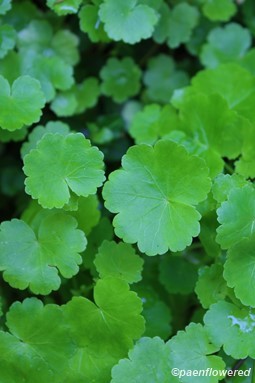
An identifying characteristic of this species is its leaves, which are round to kidney‑shaped. They measure ¼ to 2¼ inches wide and have 6 to 10 shallow, toothed lobes around the margins. The stems are hairless and slender, creeping across the ground and rooting at the nodes. The petioles are sparsely hairy and can reach up to 2 inches long.
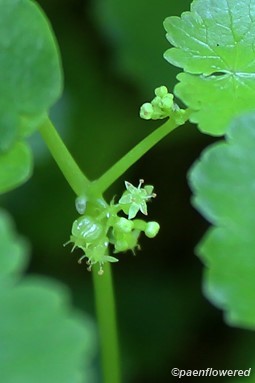
Hydrocotyle americana blooms from late June to September, with flowers borne in small umbels of 2–7 blossoms located in the leaf axils. Each flower is 1⁄16 to 1⁄8 inches across, with five small white to green petals and five stamens. This plant plays an important role in wet environments: the mats and colonies it forms help stabilize saturated soils, provide habitat for small invertebrates, and offer cover for young amphibians. The flowers are pollinated by small insects.
In addition to spreading by runners and stolons, this plant also reproduces by seed. The seeds develop inside the small capsules formed after the flowers are fertilized. Each capsule contains two seeds, which are released when the capsule splits apart.
Habitat & Range
Grows in wet woods, swampy areas and along lakes. Prefers partial to full shade and wet to waterlogged soils.
Present throughout the state.
Range: Native to the Northeastern United States and Canada, ranging from Ontario to Newfoundland and south through Pennsylvania and the Appalachian Mountains to South Carolina.
| EMP: | OBL |
|---|---|
| NCNE: | OBL |
Phenology
Flowers late June to September. Bloom duration is 2 to 4 weeks.
Characteristics
Inflorescence 2- to 7-flowered umbels located in leaf axils
Flowers white to green, 5 petals, 5 stamens; sessile or nearly so; 1⁄16 to 1⁄8″ across
Leaves round to kidney-shaped, 6 to 10 shallow lobes; ¼ to 2¼″ across; petioles sparsely hairy, abt 2″ long
Stems creeping, slender, glabrous, root at nodes
Fruit dry, two‑seeded capsule that splits into two parts at maturity (schizocarp)
Height 2 to 5 inches
Identification Tips
Leaves have a distinct round to kidney shaped form with 6 to 10 shallow lobes.
Plant Codes
S-rank: S5 (Secure)
G-rank: G5 (Secure)
Ecology
The tiny axillary umbels produce small amounts of nectar that attract minute flies, gnats, small solitary bees, and occasionally ants. Because the flowers are so small, they are visited mainly by micro‑pollinators capable of navigating the tight floral structure.
The dense mats provide humid microhabitats for springtails, small beetles, spiders, snails, and other wetland invertebrates. Their shallow cover also shelters newly metamorphosed amphibians and young salamanders moving between water and land, and supports foraging activity along the edges for small wetland birds.
By creeping and rooting at its nodes, marsh pennywort binds saturated soils, stabilizing organic muck and peat in bogs, seeps, and lake margins. Its colonies slow surface water movement, help retain fine sediments, and create cool, moist ground‑level conditions that support the biodiversity of wetland plant and animal communities.
Hydrocotyle americana American marsh-pennywort

Comments
Have you spotted this plant in your area? We'd love to hear about your experience! Share your comments or questions about the plant below. Comments are moderated before posting.