Dioscorea villosa
Dioscorea villosa wild yam

 Add to MyPlants
View Locations
Add to MyPlants
View Locations
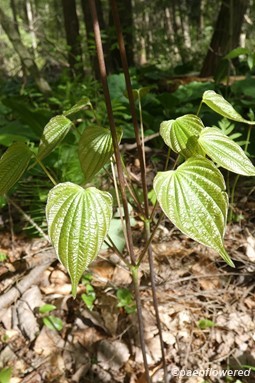
Wild yam is a rhizomatous, climbing herbaceous vine found in moist woodlands and forests. It does not have tendrils and instead uses stems to twine around nearby vegetation (or fences). It spreads either by seeds or branching rhizomes.
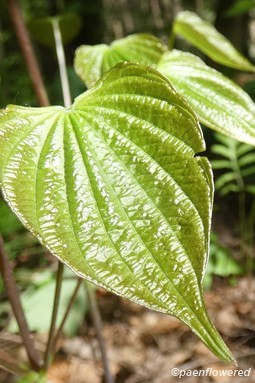
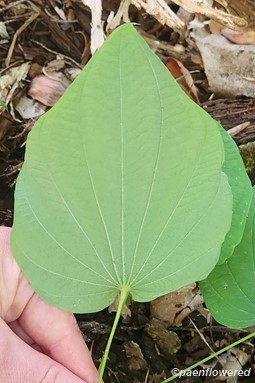
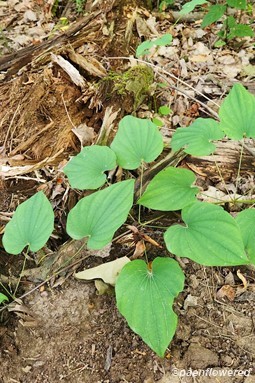
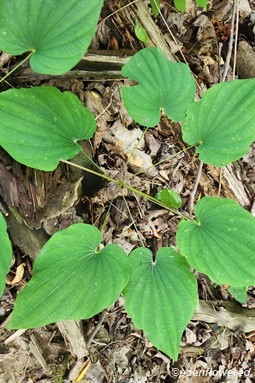
Leaves on long, hairless stalks are mostly alternate, but can also be whorled or opposite near the base of the plant. Leaf shape varies from heart-shaped to ovate, leaf tips are abruptly pointed. The upper surface of the leaves is smooth and the under surface can have varying degrees of hairyness, occaionsally fully smooth.
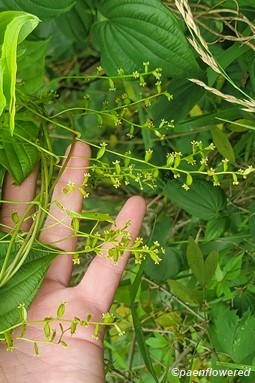
Wild yam is dioecious, producing plants with either all male or all female flowers. Female flowers grow in axillary spikes of 5 to 15 yellowish-green flowers with one flower per node. Male inflorescences are borne in branched panicles, with 1 to 4 flowers per node on each branch, each flower with 6 yellow stamens.
Habitat & Range
Frequent in moist woodlands, forests, edges of wetlands & rocky slopes. Grows best in full or partial sun. Can also grow in some shade but is not likely to flower.
Present throughout the state.
Range: New England west to Minnesota, south to Georgia and Texas.
| EMP: | FAC |
|---|---|
| NCNE: | FAC |
Phenology
Flowers late June to early July.
Fruits August to September.
Characteristics
Flowers tiny (⅛″), greenish-yellow, 6 tepals fused at the base; in loose clusters (inflorescences) growing from leaf axils
Staminate inflorescences widely branched panicles, with 1 to 4 flowers per node
Pistillate inflorescences unbranched 2″-8″ long spikes of 5-15 flowers with flowers solitary at each node; each flower positioned on top of ovary
Leaves mostly alternate, cordate to ovate, with 7 to 11 palmate veins; abruptly acuminate; variously pubescent on the under surface; glabrous 6″ petiole
Stems twining (no tendrils), glabrous, slender
Fruit winged capsule with 3 valves; 2 or rarely 1 seed per valve; seeds flat and broadly winged; green when young, turns brown when fully ripe
Height 6 - 17 feet
Plant Codes
S-rank: S5 (Secure)
G-rank: G4 (Apparently secure)
Dioscorea villosa wild yam

Comments
Have you spotted this plant in your area? We'd love to hear about your experience! Share your comments or questions about the plant below. Comments are moderated before posting.