Chamaedaphne calyculata
A peatland evergreen keeping its leathery leaves through winter light
Chamaedaphne calyculata leatherleaf

 Synonyms:
Chamaedaphne calyculata var angustifolia
Synonyms:
Chamaedaphne calyculata var angustifolia
Add to MyPlants View Distribution
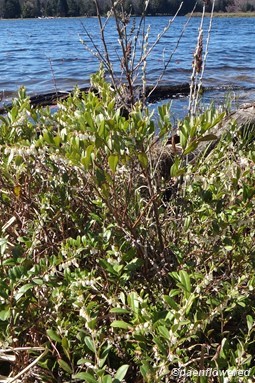
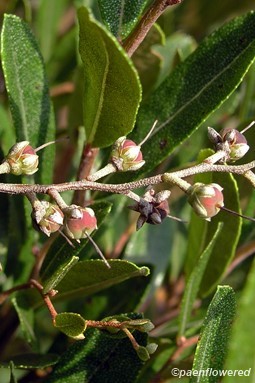
Leatherleaf is a perennial dwarf shrub that grows up to 1.5 m tall. It prefers to grow in bogs but can also be found in fens, rocky crevices, and pool margins. It is a member of the Ericaceae family and often grows in large spreading colonies. The leaves of this species are alternately arranged on the branch and are elliptical to oblong in shape. They measure 1-4 cm long to 0.5-1.5 cm wide. A characteristic that identifies this plant are the thick, leatherly leaves which are dull green on top and have small silvery scales on the undersides. The undersides can also be brown in color.
Leaf margins are typically smooth, though they can be slightly and irregularly toothed. The plant is evergreen, but the foliage often turns red‑brown in winter. The lower stems extend into peat moss, bog moss, or other sphagnum, anchoring the plant in saturated, acidic substrates.
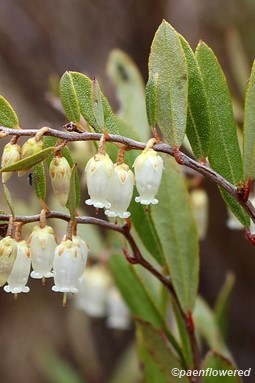
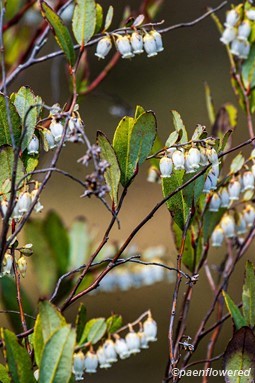
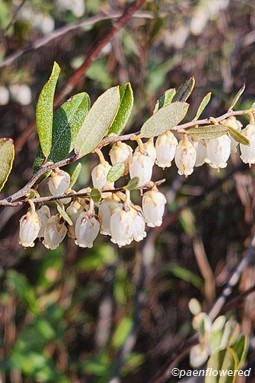
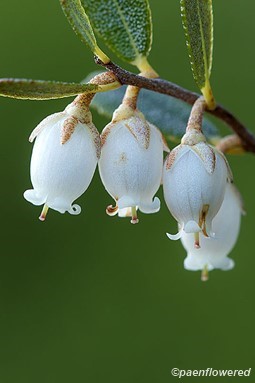
Leatherleaf flowers from April to early June and is pollinated by bees and by certain moths, including Coleophora ledi. The flowers are white, bell‑shaped, and measure about 5–6 mm long. They are borne on terminal racemes that can reach up to 12 cm in length, with each flower arising from the axils of the small bracts along the raceme. The corolla consists of fused petals forming a short tube with five small lobes.
This species reproduces in two ways. The first is by seed: after pollination, the flowers develop into small capsules that split open to release numerous tiny seeds. The second is vegetative reproduction through rhizomes, which spread horizontally beneath the sphagnum layer. This allows leatherleaf to form extensive colonies in the bogs where it grows.
Leatherleaf plays an important role in peat‑bog ecology. Its colonies help stabilize the bog surface and create structure that supports other species, including pitcher plants and other acid‑tolerant flora. The dense shrubs also provide cover for nesting mallards and other ducks. In addition, some Native American tribes have used Leatherleaf medicinally, particularly for inflammation.
Habitat & Range
Frequent in bogs, spruce muskegs and acidic wetlands. Prefers full to part sun and nutrient-poor, highly acidic soils.
Mostly found in the north of the state and at high elevations along the Allegheny front. See distribution map at BONAP.
Range: Native to northern North America, including Canada, Alaska, the Great Lakes region, New England, and parts of the northern Appalachian and northeastern United States, including Pennsylvania.
| EMP: | OBL |
|---|---|
| NCNE: | OBL |
Phenology
Flowers mid April to early June. Bloom duration is 2 to 3 weeks.
Characteristics
Inflorescence terminal raceme, up to 5″ long
Flowers white, urn-shaped, corolla petals fused; each pedicel with a leaf-like bract
Leaves alternate, thick, leathery; elliptical to oblong; irregularly toothed; brown scales below
Stems woody, stiff, slender; erect to ascending to horizontal; greenish when young, turning purplish-brown when mature; arise from rhizome; sparse minute hairs and scales
Twigs brown scales; minute, sparse hairs
Fruit dry, globe-shaped, 5-celled capsule; 3 mm across; seeds numerous, tiny
Height 1 to 3.5 feet
Identification Tips
Leaves are thick and leathery with small silvery-brown scales on the undersides.
Plant Codes
S-rank: S5 (Secure)
G-rank: G5 (Secure)
Ecology
Leatherleaf is pollinated primarily by bees, with additional visitation from certain moths such as Coleophora ledi. Its early‑season flowers provide nectar in cold, acidic bog habitats. The shrub’s dense colonies offer nesting cover for mallards and other ducks, and its foliage supports specialized lepidopteran larvae, including Coleophora ledi. Leatherleaf plays a key structural role in peat‑bog ecosystems - its extensive rhizome networks help stabilize bog mats and create microhabitats that support other acid‑tolerant species, including pitcher plants, sphagnum mosses, and other bog specialists.
Chamaedaphne calyculata leatherleaf
Add to MyPlants View Distribution

Comments
Have you spotted this plant in your area? We'd love to hear about your experience! Share your comments or questions about the plant below. Comments are moderated before posting.