Clinopodium vulgare
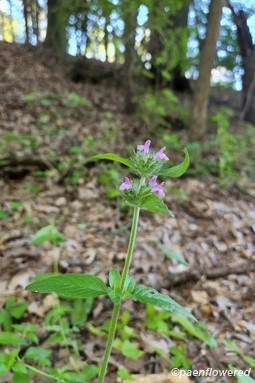
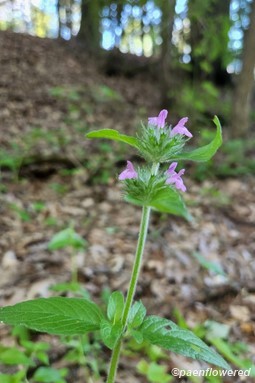
A small hairy plant with pink flowers
Clinopodium vulgare wild basil

 Add to MyPlants
View Locations
Add to MyPlants
View Locations
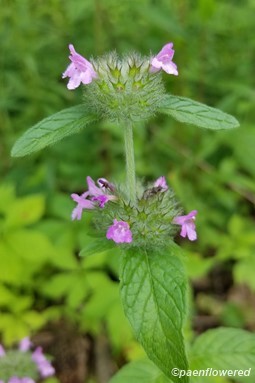
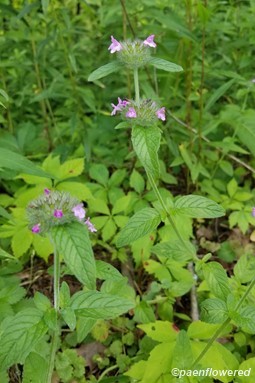
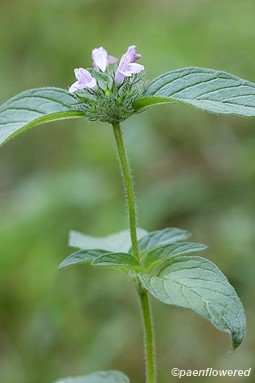
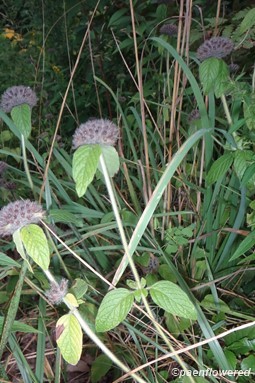
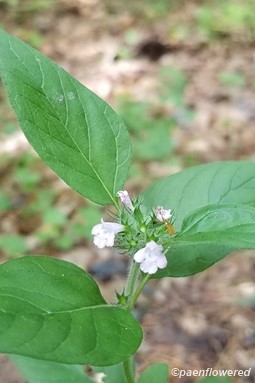
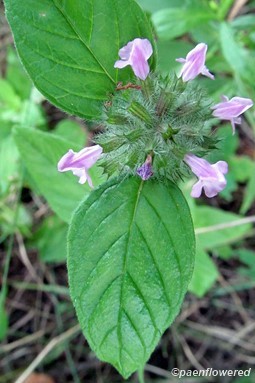
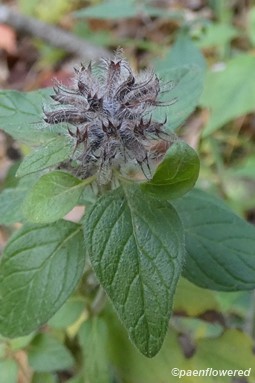
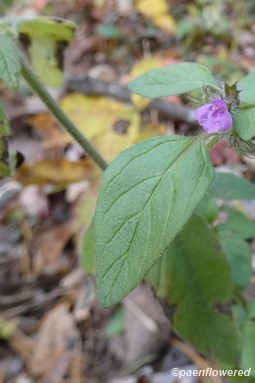
This is a hairy plant with slightly toothed, pointed-oval leaves. As a member of the mint family it has a stem that is square in cross section. It is native to northeastern United States but was probably introduced to more southern parts from Europe where it is an abundant plant. The stem is covered with small hairs. The pink-purple (sometimes white) flowers are arranged in a rounded cluster that is covered with white wooly hairs. These hairs grow from the calyx and the bracts. Individual flowers are about ½ inch long and have an upper and lower lip and a tubular calyx constructed from five basic lobes. There are four stamens. It is generally a small plant, growing to about 20 inches tall. It is a perennial species that can be found along roadsides, in pastures and open woods, waste areas and along shorelines. It is a pioneer species, growing well in disturbed ground with alkaline soils. There are scattered populations in the West. It blooms from June to September, often with only a few blossoms at a time.
The leaves are roughly oval and opposite on the stem. The dried leaves are used as a seasoning, but they are milder than those of commercial basil which is a different species.
Habitat & Range
Common in open woods, fields, and along roadsides. Prefers well‑drained soils, moderate moisture, and full to partial sun.
Present throughout the state.
Range: Native to Europe, western Asia, and North Africa; believed to be naturalized in Canada and northern U.S.
Wetland Code: Not classified
Phenology
Flowers June to September. Bloom duration is 6 to 8 weeks.
Fruits August and September.
Characteristics
Inflorescence dense axillary whorls, stacked to form a spike-like cluster along stem; 6-12 flowers per whorl
Flowers pale purple, pink or white; 2-lipped, calyx tubular; 4 stamens; ½″ long; clustered in head-like clusters among hairy bracts
Leaves opposite; ovate to ovate-lanceolate; finely hairy on both sides; margins entire or shallowly toothed; lower leaves on short stalks, upper leaves sessile or nearly so; 1 to 2½″ long, 1″ wide
Stems square, hairy; branched toward top
Fruit four tiny brown nutlets, each containing one seed, enclosed by the persistent calyx
Height 8 to 24 inches; spread 1-2 feet
Plant Codes
S-rank: S5 (Secure)
G-rank: G5 (Secure)
Medicinal Qualities
Wild basil has been used as an astringent, expectorant, and to treat digestive issues. The plant is also believed to have anti-bacterial properties and has been used in folk medicine for wound healing
Ecology
Found in dry to mesic meadows and open woodlands, wild basil supports bees, butterflies, moths, and other insects with nectar from mid‑summer into fall.
Its hairy bracts and foliage provide microhabitats for small invertebrates, while aromatic leaves resist heavy browsing.
Colonies expand modestly by seed and rhizomes, contributing to grassland diversity.
Clinopodium vulgare wild basil

Comments
Have you spotted this plant in your area? We'd love to hear about your experience! Share your comments or questions about the plant below. Comments are moderated before posting.