Aphyllon uniflorum
A leafless parasitic forest dweller sending up solitary blooms in spring
Aphyllon uniflorum cancerroot

 Synonyms:
Orobanche uniflora
Synonyms:
Orobanche uniflora
Add to MyPlants View Locations
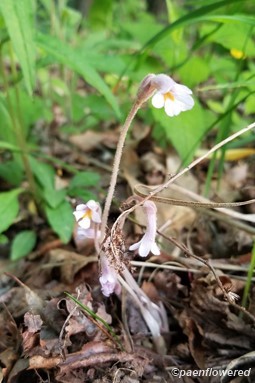
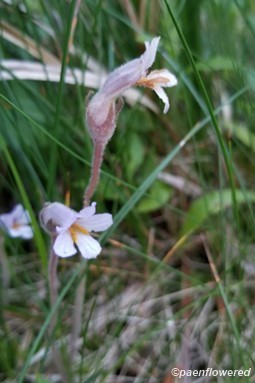
Commonly known as cancerroot, this plant is a native holoparasitic plant found across the United States and southern Canada, including Pennsylvania. It grows 2–6 inches tall and occurs in deciduous, mixed, and coniferous forests, typically in shaded, moist, leaf‑littered areas. This species is unique in having no leaves and no chlorophyll; as a holoparasite, it does not photosynthesize but instead obtains nutrients by tapping the roots of nearby host plants such as goldenrods, sunflowers and saxifrages. The genus name Aphyllon means “without leaves,” and the species name uniflorum refers to its single flower, which appears at the top of each stem.
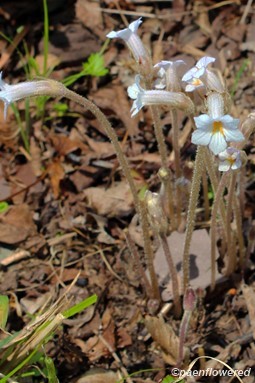
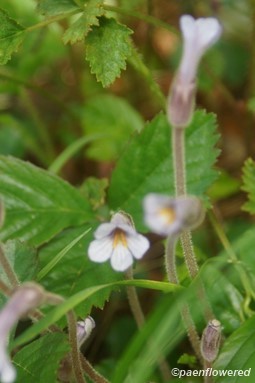
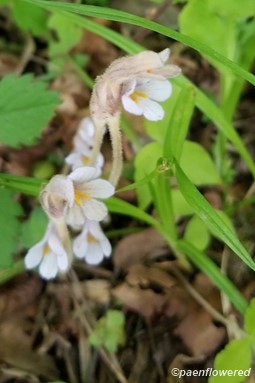
The flowers of this species emerge above ground for reproduction, while the rest of the plant remains below the surface attached to the roots of its host plants. The flowers are tubular and five‑lobed, ranging in color from purple to whitish, bluish, or pale lavender. They measure about ½–1 inch long. Blossoms appear from May to early June. After pollination, usually by bumblebees, the flowers develop into oval seed capsules containing many tiny seeds. When the capsules dry and split open, the seeds are dispersed by wind, gravity, or small animals. Germination only occurs when the seeds detect chemical signals from nearby host roots.
Cancerroot has a history of traditional medicinal use, including treatments for colds, coughs, tuberculosis, cancer, and gonorrhea. In some traditions, the roots were applied externally to soothe skin sores. Ecologically, this holoparasitic species contributes to forest biodiversity by interacting with a variety of host plants and providing nectar for bumblebees. Its presence often reflects a healthy, diverse understory community.
Habitat & Range
Grows in forests and occasionally meadows and fields. Prefers shaded, moist, leaf‑littered forest floors.
Present in most counties of the state.
Range: Native to southern Canada and much of the United States, extending from the Northeast and Great Lakes through the Midwest and South to the Rocky Mountains and Pacific Coast.
| EMP: | FACU |
|---|---|
| NCNE: | UPL |
Phenology
Flowers May to early June.
Characteristics
Inflorescence solitary, with a single flower atop each leafless stem
Flowers white to violet, interior yellow, supported by a bract; corolla tublar, 5-lobed; calyx 4- or 5-lobed; 2 cm long
Leaves no true leaves
Stem(scape) single or clusterted, pale whitish to purplish; lower part smooth, upper part near flower glandular-hairy
Fruit dry capsule; seed numerous, minute
Height 2 to 8 inches
Plant Codes
S-rank: No rank
G-rank: G5 (Secure)
Ecology
Holoparasitic plant that feeds on the roots of nearby herbaceous hosts and does not photosynthesize. Its tubular flowers provide nectar for bumblebees, which fertilize the blossoms.
The plant's unpalatable, chlorophyll‑free tissues are rarely eaten by herbivores.
By interacting with a variety of host plants and supporting native pollinators, this species contributes to forest biodiversity, and its presence often reflects a healthy, diverse understory community.
Aphyllon uniflorum cancerroot
Add to MyPlants View Locations

Comments
Have you spotted this plant in your area? We'd love to hear about your experience! Share your comments or questions about the plant below. Comments are moderated before posting.