Pedicularis canadensis
Pedicularis canadensis Canadian lousewort

 Add to MyPlants
View Distribution
Add to MyPlants
View Distribution
Pedicularis canadensis, commonly called wood betony, is a perennial herb in the broomrape family (Orobanchaceae). It is native to eastern and central North America, including southeastern Canada, the eastern and central United States, and eastern Mexico. In Pennsylvania it grows in dry woodlands, open forests, prairies, thickets, and clearings. This species is hemiparasitic and forms haustorial (root‑attaching) connections to nearby plants. It commonly attaches to grasses and other herbaceous species, but it is capable of parasitizing both herbaceous and woody hosts while still producing its own chlorophyll.
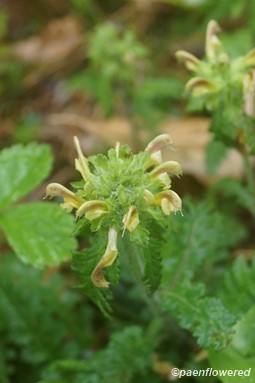
Wood betony ranges from 6 to 12 inches tall and has a cluster of basal leaves that are typically up to 6 inches long and about 2 inches wide. These basal leaves form a rosette at ground level. The flowering stem rises from the center of the rosette and can be greenish to reddish brown, with a covering of long white hairs.
Along the stem, the stem leaves are alternate and pinnatifid, with rounded, scalloped lobes that give the foliage a softly fern‑like appearance; upper leaves are smaller and less deeply cut.
This species blooms from late April through May, producing flowers at the top of the flowering stems. The flowers are usually yellow, although some populations have brownish‑red forms. Each flower is about three‑quarters of an inch long and has a tubular, two‑lipped corolla. The upper lip forms a hood over the reproductive parts, and the lower lip provides a landing platform for visiting insects. The flowers have a light fragrance that attracts bees and other pollinators.
After fertilization, each flower is replaced by a capsule about one‑half inch long. The capsule is angular and is enclosed by a hairy, persistent calyx, which can give the fruit a fuzzy appearance. Inside the capsule are numerous small seeds. The plant often forms loose groups in suitable habitat, and these clusters develop over time through self‑seeding, since the species does not spread vegetatively.
Habitat & Range
Frequent in open woodlands, forest margins and dry clearings. Prefers full sun to part shade and mesic to dry, well-drained soils.
Present throughout the state.
Range: Native to southeastern Canada, the eastern and central United States, and eastern Mexico.
| EMP: | FACU |
|---|---|
| NCNE: | FACU |
Phenology
Flowers late April through May. Bloom duration is about 3 weeks.
Characteristics
Inflorescence dense, leafy terminal spike
Flowers corolla yellow to purplish, tubular, two-lipped; upper lip forms a hood and is distinctly longer than lower
Leaves mostly basal leaves
basal leaves 3 to 6″ long and 1 to 2″ wide; deeply pinnatifid with rounded, crenate‑serrate lobes
stem leaves alternate; pinnatifid with rounded, crenate‑serrate lobes; smaller and less deeply cut upward
Stems green to reddish-brown; covered in hairs
Fruit capsule dry, dehiscent, angular; calyx hairy, persistent; ½″ long; seeds numerous
Height 6 to 12 inches
Plant Codes
S-rank: S5 (Secure)
G-rank: G5 (Secure)
Ecology
Pollinated primarily by bumblebees, mason bees, and halictid bees, which are strong enough to enter the two‑lipped corolla.
Deer and rabbits may lightly browse the foliage, but most herbivores avoid the plant because it contains iridoid glycosides.
By tapping into the roots of nearby plants, most often grasses and forbs, wood betony softens local competition and creates small gaps that support a more diverse mix of understory species. It fits naturally into open woods, forest margins, dry clearings, and savanna‑like barrens, where its hemiparasitic growth helps maintain a balanced and species‑rich groundlayer.
Pedicularis canadensis Canadian lousewort


Comments
Have you spotted this plant in your area? We'd love to hear about your experience! Share your comments or questions about the plant below. Comments are moderated before posting.