Verbena urticifolia
A native vervain lifting slender spikes of tiny white flowers
Verbena urticifolia white vervain

 Add to MyPlants
View Distribution
Add to MyPlants
View Distribution
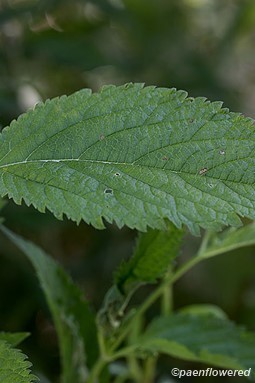
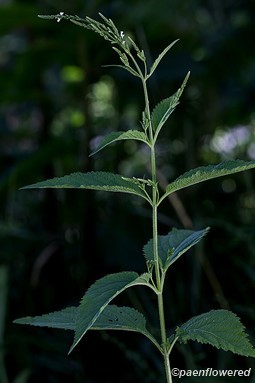
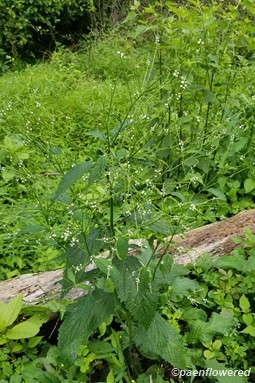
This native plant is a member of the vervain family. It can be an annual, biennial or short-lived perennial. In general form the plant resembles the related blue vervain. The leaves are opposite, simple, and toothed. The leaf stalks are up to 2 inches long. The leaves resemble those of nettles (genus Urtica) and give the plant its species name. The stem is rigid and green and often covered with long spreading hairs.
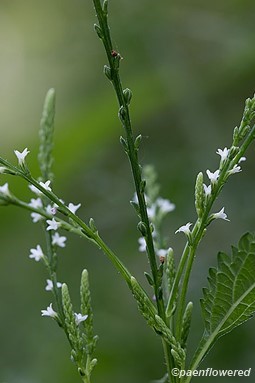
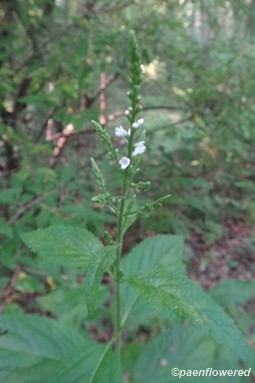
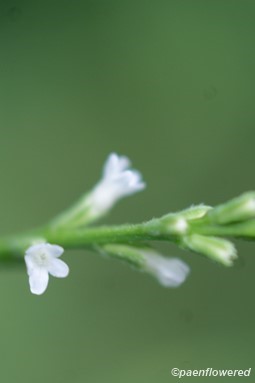
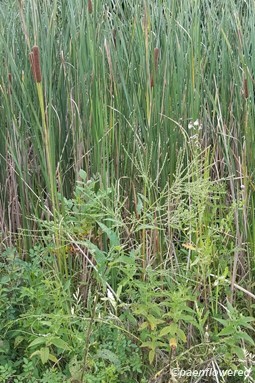
The small white flowers bloom along very slender branched spikes. These spikes can be up to 2 feet high, but only a few flowers bloom at any one time. Individual flowers are only ⅛ inch wide. Each consists of a five-lobed corolla and a tubular green calyx with 5 lobes. The white flower color of this species is unusual because most members of the genus have bluish flowers. The plant grows 3-5 feet high and is found in thickets and wood edges in most of the eastern half of North America. It blooms from June to September. When it grows with proper space, the plant can take the form much like that of blue vervain.
Reproduction of this species is only by seed. Several species of insects feed on the leaves and birds will eat the seeds. The bitter taste deters browsing by deer.
Habitat & Range
Grows in woodland edges, moist fields, meadows, roadsides, and disturbed ground. Prefers full sun to part shade and moist to mesic soils.
Present throughout the state.
Range: Native to the eastern and central United States and southern Canada.
| EMP: | FAC |
|---|---|
| NCNE: | FAC |
Phenology
Flowers late June to September. Bloom duration is about 6 weeks.
Characteristics
Inflorescence slender, elongated terminal spikes, clustered on main stem and upper branches; flowers widely spaced
Flowers tiny; corolla white, tubular, slightly 2-lipped, with 5 short, slightly spreading lobes, lowest one notched; 4 inserted stamens, 1 pistil; calyx tubular, 5-lobed, nearly as long as corolla; ⅛″
Leaves simple, opposite, broadly lanceolate to ovate; coarsely and often doubly serrate; surface rough, slightly prickly; petioles up to 2″
Stems stiff, erect, short-hairy to long-hairy, angled; branched in the upper plant, lower stem unbranched or sparsely branched; light green
Fruit dry schizocarp; splits into four reddish-brown, oblong nutlets; 1 seed per nutlet
Height 2 to 6 feet
Plant Codes
S-rank: S5 (Secure)
G-rank: G5 (Secure)
Ecology
Pollinated by bees, flies, and butterflies. The leaves support several species of insect larvae and birds eat the seeds and small fruits. The foliage is bitter and generally avoided by deer.
By flowering through mid‑summer and thriving in semi‑open, disturbed habitats, white vervain helps sustain pollinators and insect communities in old fields, woodland edges, and other transitional ecosystems.
Verbena urticifolia white vervain


Comments
Have you spotted this plant in your area? We'd love to hear about your experience! Share your comments or questions about the plant below. Comments are moderated before posting.