Polygala cruciata
Polygala cruciata crossleaf milkwort

 Synonyms:
Polygala aquilonia, Polygala cruciata var. aquilonia
Synonyms:
Polygala aquilonia, Polygala cruciata var. aquilonia
Add to MyPlants View Distribution
Crossleaf milkwort, is a small but showy herbaceous annual native to eastern North America. Considered rare and endangered in the state of Pennsylvania, Polygala cruciata is known for being a unique wildflower due to its distinctive floral structure and leaf arrangement.
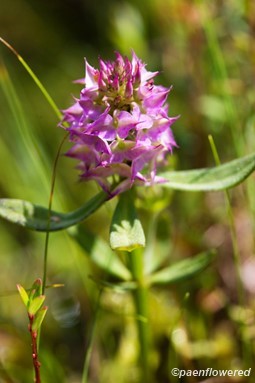
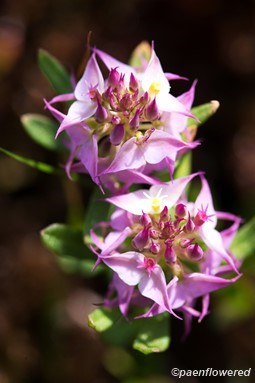
This intriguing plant is less than 12 inches tall, with tiny flowers packed into barrel-shaped heads at the tips of stems or short branches. These heads measure about ½–2½ inches long and under ¾ inch thick. Each flower bears two large wing-like inner sepals, three small outer sepals, and three petals fused into a central tube. The blossoms, ranging from deep pink to greenish, are only 2–4 mm long.
Leaves occur in whorls of three or four along the square, hairless stem. They are dark green, linear to elliptic, entire, and sessile, measuring about 1–3 inches long.
Though crossleaf milkwort bears a distinctive floral design, it is easily overlooked because of its small stature and rarity. Flowering from July to September, it sets seed in autumn when the capsules split to release two blackish-brown oval seeds. These may fall by gravity or be carried by water, and ants are thought to aid dispersal, drawn to the fleshy appendage on each seed. The compact flower heads provide nectar mainly for small native bees, including sweat bees and solitary bees, contributing to pollinator diversity. Deer and rabbits may browse occasionally, but the plant’s small size and low nutritional value make it generally avoided — a trait that helps ensure its survival.
Crossleaf milkwort prefers full sun to partial shade in bogs, wet meadows, and swampy openings, rooting best in acidic, sandy or peaty soils. It is usually found in wetlands, though occasional records occur in moist non-wetland sites. In Pennsylvania, it has been documented in southeastern and southwestern counties.
Crossleaf milkwort is threatened by competition from aggressive plants, habitat disturbance, and especially wetland drainage, and could benefit from restoration efforts. It remains a subtle yet beautiful component of Pennsylvania’s wetland flora.
Habitat & Range
Rare in boggy pastures, mountain bogs and swampy openings. Prefers sun to partial shade, rooting best in acidic, sandy or peaty soils that are consistently moist to wet.
Mostly found in southeast and southwest of the state. See distribution map at BONAP.
Range: Native to eastern North America, from Maine to Minnesota and south to Florida and Texas. In Pennsylvania, it is considered endangered.
| EMP: | FACW |
|---|---|
| NCNE: | FACW |
Phenology
Flowers late July to September.
Fruits August into September.
Characteristics
Inflorescence cylindric raceme; flower heads ½–2½″ long and less than ¾″ wide
Flowers tiny, rose-purple to greenish; 3 small outer sepals and 2 inner wing-like larger sepals; 3 petals fused into short tube, lower petal forms a keel with fringed crest at the tip; 2-4mm long
Leaves whorls of 3 or 4; dark green, sessile, margins entire; linear to narrowly elliptic; 1 to 3″ long
Stems simple or lightly branched; square, smooth
Fruit dry capsule; seeds 2, round, black or brown
Height 4 to 12 inches
Plant Codes
PA status: PE (Endangered)
S-rank: S1 (Critically Imperiled)
G-rank: G5 (Secure)
Ecology
Attracts small native bees and occasional flies, though the flower heads are not a major nectar source. Ants aid in seed dispersal.
Deer and rabbits may graze at times, but the plant’s small size and low nutritional value make it generally avoided.
Crossleaf milkwort contributes to plant diversity in bog ecosystems, filling a niche among low-statured annuals.
Polygala cruciata crossleaf milkwort
Add to MyPlants View Distribution


Comments
Have you spotted this plant in your area? We'd love to hear about your experience! Share your comments or questions about the plant below. Comments are moderated before posting.