Polygala verticillata
Polygala verticillata whorled milkwort

 Synonyms:
Senega verticillata
Synonyms:
Senega verticillata
Add to MyPlants View Distribution
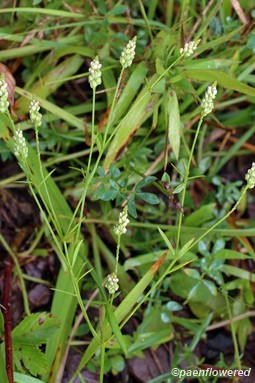
Despite being almost invisible due to its small size, and often disregarded as a valued wildflower, whorled milkwort, native to much of the continental U.S. including Pennsylvania, contributes to plant biodiversity by providing nectar for small bees and flies. Easily overlooked by hikers, this tiny 4–12 inch annual herb blooms from late June to October, bearing conical, spike‑like clusters up to 2 inches long of minute white to greenish‑white or pink flowers at stem tips and branch ends.
Whorled milkwort grows in delicate clumps of slender stems with narrow leaves. Leaves are whorled below in groups of 3–5, shifting to an alternate arrangement above, linear to narrowly elliptic with pointed tips. Bracts appear just beneath the flower clusters. After flowering, lower blossoms drop as ovoid capsules mature, releasing small, hairy brown‑black seeds before the capsules themselves detach, leaving tiny nubs along the stem.
Whorled milkwort thrives in full sun to part shade, favoring acidic, sandy or rocky soils. It grows in open woods, fields, prairies, cliffs, ledges, and disturbed sites such as roadsides or maintained clearings. Though resilient in disturbed habitats, local populations may be sparse where aggressive plants outcompete it.
Polygala comes from the Greek words 'polys', meaning much, and gala meaning milk, referring to the old belief that milkworts would aid in milk secretion. 'Verticillata' means whorled.
Habitat & Range
Grows in meadows, fields, woodlands, on cliffs and ledges. Prefers full sun to part shade and dry to moderately moist, well-drained soils.
Present in most counties of the state.
Range: Native to much of the eastern and central United States and southern Canada; widespread from Maine and Ontario west to Michigan and Minnesota, and south to Virginia, North Carolina, Tennessee, and parts of the Midwest and Great Plains.
| EMP: | UPL |
|---|---|
| NCNE: | UPL |
Phenology
Flowers late June to early October. Blooming period is 10 to 14 weeks.
Characteristics
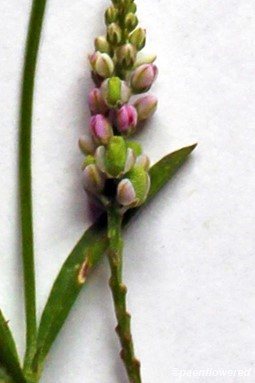
Inflorescence cylindric-conical, continuous raceme, avg. 1.6″; blooming starts at at bottom; terminal on tips of stems and branches
Flowers greenish-white or pinkish; 3 smaller outer sepals and 2 larger petal-like inner sepals; 3 petals fused into a fringed, crested column
Leaves linear, whorled below and alternate above
Stems erect, slender, branched, smooth, purplish near the base; grow from small taproot
Fruit dry, oval, slightly flattened dehiscent capsule; 2 seeds, each with 2-lobed appendage as long as the seed
Height 4 to 12 inches
Plant Codes
S-rank: No rank
G-rank: G5 (Secure)
Ecology
Tiny flowers provide nectar for small native bees and flies, with occasional butterfly visits.
Foliage may host caterpillars and minor insect browsing, but deer rarely feed on this inconspicuous annual.
Tolerant of disturbance and drought, persisting in sandy or rocky soils.
Polygala verticillata whorled milkwort
Add to MyPlants View Distribution


Comments
Have you spotted this plant in your area? We'd love to hear about your experience! Share your comments or questions about the plant below. Comments are moderated before posting.