Agalinis paupercula
Agalinis paupercula small-flower false foxglove

 Add to MyPlants
View Locations
Add to MyPlants
View Locations
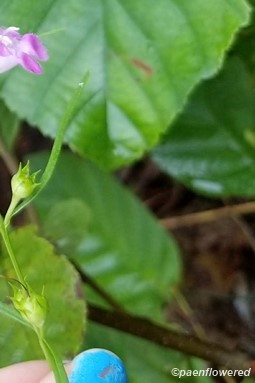
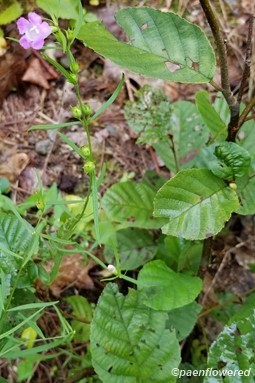
Agalinis paupercula, commonly known as small-flower false foxglove, is a slender, herbaceous annual with wiry, 4‑angled stems, typically 1–2 feet tall, occasionally reaching 3 feet. The leaves are mostly opposite, becoming subopposite or alternate on the upper stem and branches. They are stalkless, linear, smooth‑margined, and hairless, pointed at the tip, and measure up to 1.5 inches long and about 1⁄16 to ⅛″ wide.
Small-flower false foxglove flowers in August and September, producing pink to purple, funnel‑shaped blossoms about ¾ inch long. The flowers are solitary or occasionally paired on very short stalks in the leaf axils along the upper stem and its branches. The corolla is tubular at the base with five spreading lobes, the upper two slightly smaller than the lower three and is glabrous, without marginal hairs.
Dark purple spots and pale yellow stripes mark the inside of the flower. The blossoms contain four stamens with smooth, white‑tipped anthers and a single slender white style within the floral tube. The calyx is tubular at the base and divided into five narrow, tapering lobes that are nearly as long as the calyx tube.
This false foxglove is often confused with purple false foxglove (Agalinis purpurea), a larger species with noticeably bigger flowers. It is also similar to slender‑leaved false foxglove (Agalinis tenuifolia), which can be distinguished by its longer flower stalks and narrower leaves.
Small-flower false foxglove is hemiparasitic and obtains part of its nutrition from the roots of nearby plants, often grasses and other herbaceous species. It is visited and pollinated by bees, though self‑pollination can also occur. The plant spreads by seed and is native to southern Canada and the northeastern to north‑central regions of the United States, where it grows in open woods, woodland borders, shorelines, barrens, and clearings. In Pennsylvania, it is listed as endangered due to its limited distribution and the vulnerability of its habitats, though active land management can support its persistence.
Habitat & Range
Rare in moist sandy ground and along pond shores. Prefers full sun or open shade and moist to seasonally wet conditions.
Found in a few counties in south-east. See distribution map at BONAP.
Range: Across southern Canada and the northeastern to north‑central United States, especially in regions with open, sandy, or lightly wooded habitats.
| EMP: | FACW |
|---|---|
| NCNE: | OBL |
Phenology
Flowers August and September. Blooming period is 6 to 8 weeks.
Characteristics
Inflorescence slender, elongate axillary racemes along the upper stem
Flowers corolla pink to purple with long slender tube and 5 spreading lobes, glabrous; calyx lobes nearly as long as the calyx tube; short-stalked; 10-18 mm long
Leaves entire, glabrous, linear, acute at the tip; opposite below, becoming alternate above; sessile; 1.5″ long
Stems smooth, slender, 4-angled; erect to ascending, may branch
Fruit dehiscent, nearly round capsule, multi-seeded; seeds tiny, dark brown to black, angular or irregularly angled, surface reticulate
Height 1 to 2 feet avg, can grow up to 3 feet
Identification Tips
Corolla has 5 lobes - the upper two slightly smaller than the lower three.
Calyx lobes nearly as long as the corolla tube.
Plant Codes
PA status: PE (Endangered)
S-rank: S1 (Critically imperiled)
G-rank: G5 (Secure)
Ecology
The pink, spotted flowers of A. paupercula attract native bees, which provide most of its pollination even though the plant can self‑pollinate.
As a hemiparasite, it forms root connections with nearby grasses and herbaceous plants, drawing water and nutrients while still photosynthesizing on its own.
Within the wetland landscape, it occupies open, sandy or peaty habitats where light, moisture, and sparse competition allow this delicate annual to thrive.
Agalinis paupercula small-flower false foxglove


Comments
Have you spotted this plant in your area? We'd love to hear about your experience! Share your comments or questions about the plant below. Comments are moderated before posting.