Circaea alpina
Circaea alpina alpine enchanter's-nightshade

 Synonyms:
Circaea alpina ssp. alpina
Synonyms:
Circaea alpina ssp. alpina
Add to MyPlants View Distribution
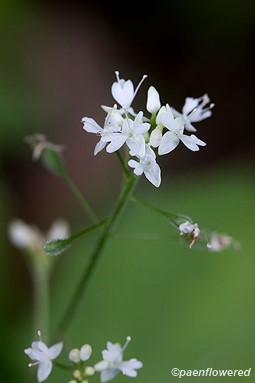
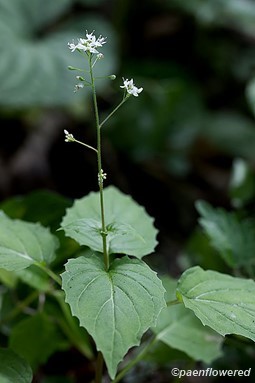
Circaea alpina is a native, herbaceous perennial in the evening primrose family (Onagraceae), widespread across much of North America and found occasionally in Pennsylvania’s cooler, shaded forests and Appalachian uplands. Typically growing 4–12 inches tall, it bears a terminal raceme with a more crowded cluster at the top — of tiny white flowers, each with two bilobed petals, two sepals, and two stamens — a distinctive floral structure. Blooming primarily from May through October, each flower gives rise to a burr-covered fruit that clings to fur, feathers, or clothing, dispersing its single seed to new woodland niches.
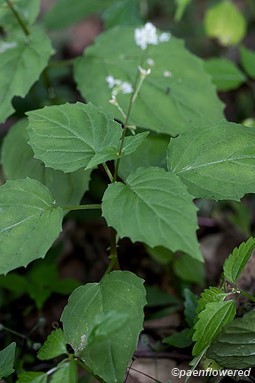
The heart-shaped leaves are dark green, coarsely toothed, and hairless, arranged in opposite pairs that emerge at right angles to one another. The petioles are subtly winged beneath, creating a whorl-like backdrop that frames the delicate white flowers with quiet elegance.
Circaea alpina prefers cool, moist to wet, shaded environments — including swamps, streambanks, moss-covered logs, and the misty edges of waterfalls.
The plant attracts small pollinators such as Halictid bees, little carpenter bees, Syrphid flies, and bee flies, primarily for its pollen. Deer and rabbits may browse the foliage occasionally, though it is not a significant food source due to its small size and low nutritional value.
Small enchanter’s nightshade is a quiet but important member of Pennsylvania’s native flora, contributing to the ecological fabric of shaded forest understories. Named for the Greek enchantress Circe — famed for her magical powers and knowledge of potent herbs — the plant itself is non-toxic, offering no danger despite its evocative name.
Habitat & Range
Occasional in hemlock forests, wooded slopes and stream banks. Prefers part to full shade in dappled forest light and consistenly moist to wet soil.
Found in the north of the state and along the higher elevations of the Allegheny front. See distribution map at BONAP.
Range: Native to cool, temperate regions across North America, from Alaska and Canada to the northern United States and Appalachian forests, including parts of Pennsylvania
| EMP: | FACW |
|---|---|
| NCNE: | FACW |
Phenology
Flowers May to October.
Characteristics
Inflorescence terminal raceme with up to 15 flowers, crowded near top, on ascending pedicels
Flowers tiny, white or pinkish; 2 bilobed (notched) petals, 2 sepals, 2 stamens
Leaves simple, opposite; ovate to heart-shaped, dark green, smooth; coarsely dentate; petiole winged beneath; 2-6 cm long
Stems erect, slender, branched, green; with sparse, short hairs
Fruit small, ovoid indehiscentbur-like capsule, rounded at the tip, covered with hooked hairs; uni-locular and 1-seeded; less than ⅛″ long
Height 4 to 12 inches
Plant Codes
S-rank: No rank
G-rank: G5 (Secure)
Ecology
Tiny flowers attract small pollinators such as Halictid bees, little carpenter bees, Syrphid flies, and bee flies, though they offer little nectar.
Burr-like seed capsules cling to the fur of small mammals or the feathers of ground-foraging birds, helping disperse seeds to new forest niches.
Deer and rabbits may occasionally browse the foliage, but often overlook it due to its small size and low nutritional value.
Circaea alpina alpine enchanter's-nightshade
Add to MyPlants View Distribution


Comments
Have you spotted this plant in your area? We'd love to hear about your experience! Share your comments or questions about the plant below. Comments are moderated before posting.