Epilobium ciliatum
A hairy perennial with clusters of pink to white flowers at end of stems
Epilobium ciliatum fringed willowherb

 Synonyms:
Epilobium ciliatum ssp. ciliatum
Synonyms:
Epilobium ciliatum ssp. ciliatum
Add to MyPlants View Locations
The fringed willowherb is a softly hairy perennial in the evening primrose family, growing on slender, branching stems up to about 4 ft tall. Its flowers are small and easily overlooked, sometimes mistaken for members of the pink family, though pinks have five petals rather than the four characteristic of willowherbs.
This species is widespread across northern and western North America, occurring throughout most of the United States except the Deep South, and extending well into Canada and Alaska. It became established in parts of Europe in the early 20th century.
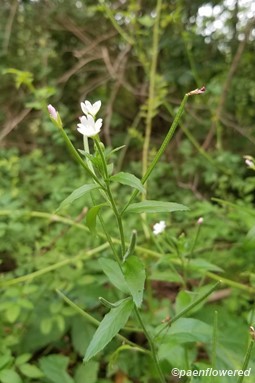
Leaves are opposite below and often alternate above, lanceolate and finely toothed, with modestly visible venation. Stems and leaves are softly hairy throughout, lacking bristly or glandular hairs.
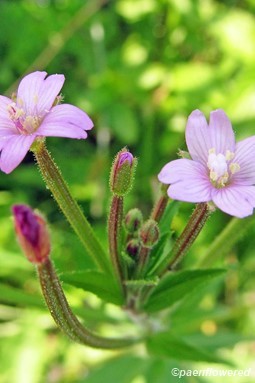
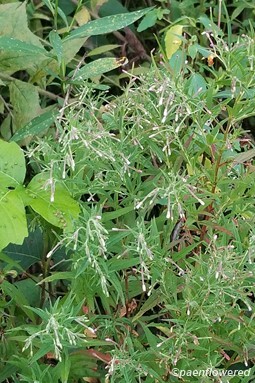
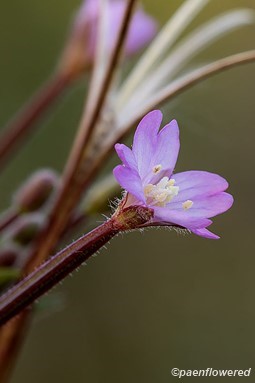
At the ends of the stems, the upper leaf axils bear numerous small pink, pale purple, or white flowers that together form a loose, terminal‑looking cluster. Each flower has four petals that are distinctly notched to form two small lobes, often with darker veining. The style is slender and white, ending in a slightly enlarged, 4‑lobed stigma. The long structure behind the petals is the inferior ovary, sometimes mistaken for a fused corolla tube. The fruit is a slender, hairy capsule up to 10 cm long, containing many downy seeds that disperse widely on the wind.
This species is primarily a wetland plant but also occupies a wide range of other habitats, including ditches, streambanks, moist meadows, disturbed ground, and roadsides. It spreads both by seed which are dispersed widely by wind on the silky coma, and by short rhizomes that allow local clonal expansion. It is also known as American willowherb, hairy willowherb, or northern willowherb. Three subspecies are recognized, but only Epilobium ciliatum subsp. ciliatum occurs in Pennsylvania.
Habitat & Range
Occasional in moist, open woodlands, meadows and fields, edges of wetlands, along pond shores and wet areas. Prefers full to partial sun and moist to wet soils.
Present throughout the state except the most southernmost counties.
Range: Native to Southern Canada and most of the United States including Pennsylvania.
| EMP: | FAC |
|---|---|
| NCNE: | FACW |
Phenology
Flowers June to September. Blooming period 12 to 14 weeks.
Characteristics
Inflorescence solitary flowers in the axils of the upper leaves, forming a loose, terminal‑looking cluster; flowers numerous
Flowers corolla white to pink with 4 notched petals; short-stalked; ¼ to ⅓” across; 4 oblong-elliptic greenish sepals with reddish or purple tinges; style slender, white, with a slighly enlarged stigma; 8 stamens
Leaves simple, opposite below inflorescence, becoming alternate above; ovate to lance-elliptic, sessile; few scattered teeth along margins; mid-vein pronounced, sometimes with purple tinges along margins; lower leaves hairless, upper leaves near inflorescence bear fine hairs; 1-3″ long, 1″ wide
Stems single main stem, erect, branching in the upper part; pubescent in the upper part, hairless to sparsely hairy below
Rhizomes creeping, slender, forming loose colonies
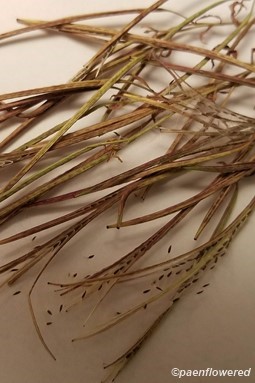
Fruit dry, dehiscent, slender 4-valved capsule; seeds brown, narrowly conical, longitudinally ribbed with white silky tuft of hairs
Height 1 to 4 feet avg, max 5 feet
Plant Codes
S-rank: S5 (Secure)
G-rank: G5 (Secure)
Ecology
The flowers attract a variety of pollinators, including bees, flies, and occasionally hummingbirds. The plant serves as a larval host for several moth species, and its foliage is eaten by a range of small herbivores, including leaf‑feeding insects and, at times, deer.
Like many willowherbs, it readily colonizes disturbed wet ground and plays an early role in wetland succession.
Epilobium ciliatum fringed willowherb
Add to MyPlants View Locations


Comments
Have you spotted this plant in your area? We'd love to hear about your experience! Share your comments or questions about the plant below. Comments are moderated before posting.