Epilobium hirsutum
Epilobium hirsutum hairy willowherb

 Add to MyPlants
View Locations
Add to MyPlants
View Locations
Hairy willowherb is a rhizomatous flowering plant in the evening primrose family. It normally grows as a perennial in most regions but can behave as an annual in harsher climates. Native to North Africa and Eurasia, it is considered an invasive species and a weed in parts of the northern United States. It may have been introduced through ship ballast or contaminated nursery stock, and it has also been sold as a garden plant, contributing to its spread in the Northeast and Great Lakes regions.
The hairy stems and leaves give this species its name hirsutum, Latin for 'hairy'. The leaves are mostly opposite, sessile, and lanceolate to narrowly oblong. They are coarsely toothed, with outward‑pointing teeth that create a dentate margin, becoming more finely serrulate toward the upper stem.
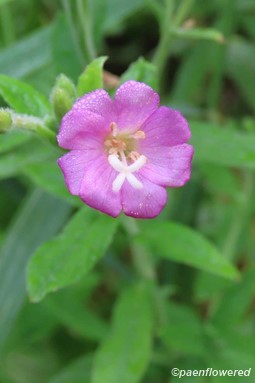
E. hirsutum grows up to 6 feet tall and bears pink, primrose‑like flowers. The blooms appear from late June to September and arise singly from the leaf axils along the upper portion of the stem. Each flower is about ¾ inch across.
Hairy willowherb thrives in sunny moist environments including wetlands, low areas, in ditches, along roadsides, and along stream beds. The plant can be self-pollinating or be pollinated by the many types of insects that visit its flowers. The elephant hawkmoth caterpillar feeds on its leaves.
This species reproduces both by seed and vegetatively through stolons. After flowering, it produces a slender seed capsule about 1–1.5 inches long that contains numerous oblong, flattened seeds. As the capsule dries, it splits open and releases the seeds, which are carried by the wind on silky white hairs. Vegetative reproduction occurs when a horizontal stolon forms a rosette of leaves; if this rosette becomes separated from the parent plant, it develops an aerial shoot and grows into a new individual.
Habitat & Range
Infrequent in wet fields, marshes, low areas and ditches. Prefers full sun and consistenly moist to wet soils.
Mostly found in northern counties. See distribution map at BONAP.
Range: Native to temperate Eurasia extending into Africa; widely naturalized in disturbed, moist habitats across Europe, Asia, and parts of North America.
| EMP: | FACW |
|---|---|
| NCNE: | FACW |
Phenology
Flowers July to September. Blooming period is 8 to 10 weeks.
Characteristics
Inflorescence loose, elongated raceme consisting of solitary flowers arising from leaf axils along upper stem
Flowers reddish-purple with pale centres, 4 shallowly notched petals, 4 sepals, 8 stamens; abt ¾″ across
Leaves mostly opposite, become alternate near the inflorescence; primarily lanceolate, stalkless, somewhat clasping; pubescent on both sides; coarsely toothed below becoming more sharply serrulate toward the upper stem; mid-vein predominant; 2-5″ long, widest below the mid-point
Stems erect, branched, densely hairy
Fruit dry hairy dehiscent capsule, 1-3″ long including the style base; seeds oblong, flattened, with tuft of white hairs for wind dispersal
Rhizome long, creeping, extend up to 2 feet or more, new stems produced at rhizome nodes
Height 2-4 feet avg.; can grow up to 6 feet
Ecology
Hairy willowherb can self‑pollinate, but it is most often pollinated by a wide range of insects. Its open, nectar‑rich flowers attract bees, hoverflies, butterflies, and moths, all of which can transfer pollen as they forage. Like other willowherbs, it plays an important role in supporting generalist pollinators during mid‑ to late‑summer when nectar sources may be limited.
The elephant hawkmoth caterpillar feeds on willowherbs, including this hairy willowherb, using the leaves as a larval host plant.
Epilobium hirsutum hairy willowherb


Comments
Have you spotted this plant in your area? We'd love to hear about your experience! Share your comments or questions about the plant below. Comments are moderated before posting.