Ribes americanum
Ribes americanum wild black currant

 Add to MyPlants
View Locations
Add to MyPlants
View Locations
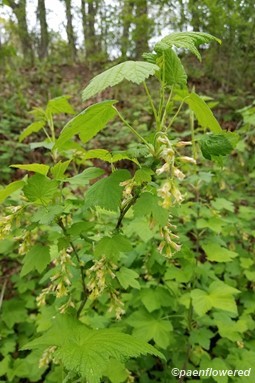
Commonly known as American black currant, wild black currant, or eastern black currant, Ribes americanum is native to Canada and the northern United States, including Pennsylvania. This deciduous shrub in the gooseberry family (Grossulariaceae) grows in moist woodlands, streambanks, sedge meadows, conifer bogs, rocky ravines, and partially shaded forest understories. It typically reaches 20–60 inches in height and often forms loose clumps or small thickets through spreading basal shoots.
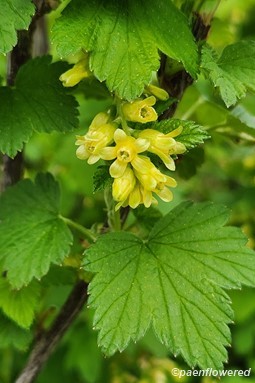
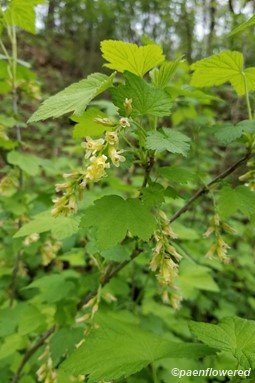
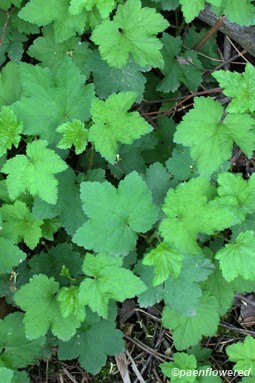
Wild black currant is known for its smooth, round black berries, which are edible and most often used cooked in jams or preserves due to their strong flavor. It flowers in late spring, producing small pale yellow to greenish blossoms that are bell‑ to tubular‑shaped and arranged in drooping racemes of up to fifteen flowers. The leaves are broadly round with three to five shallow, maple‑like lobes. Their upper surfaces are dull green and smooth, while the undersides are paler and dotted with tiny yellowish resin glands — a helpful identifying feature. Leaf margins are finely toothed, and each leaf measures about 1.5 to 3 inches wide.
The flowers of this plant attract many types of bees, including species of Augochlora and Ceratina. The plant reproduces in two ways. First, by seed: birds and small mammals disperse the seeds after eating its fruit. Second, it spreads vegetatively through basal shoots, which allow the shrub to form clumps or loose thickets in suitable habitats.
Habitat & Range
Occasional in moist woods, marshes, and thickets. Prefers partial shade and moist to wet soils.
Present throughout the state.
Range: Native from southern Canada south through the northern United States, extending from the Dakotas and Minnesota eastward to New England and the Mid‑Atlantic, including Pennsylvania.
| EMP: | FACW |
|---|---|
| NCNE: | FACW |
Phenology
Flowers late April through May. Bloom duration is 2 to 3 weeks.
Characteristics
Inflorescence drooping racemes; up to 15 flowers
Flowers corolla pale-yellow to greenish, tubular- to bell-shaped, 5 rounded lobes; lanceolate bracts at flower base
Leaves broadly round with 3-5 maple-like lobes; upper surface dull- to medium-green, smooth; lower surface paler, with yellowish resin glands; margins finely serrate; 1.5-3″wide/long
Stems erect, thornless, glabrous; green to reddish-brown; arise in clumps from basal shoots
Fruit smooth, black, round berry; abt. 1 cm wide
Height 1.5 - 5 feet
Identification Tips
Lower leaf surface has yellowish resin glands (glandular dots).
Plant Codes
S-rank: S5 (Secure)
G-rank: G5 (Secure)
Ecology
The flowers are visited by small bees and flies, including species of Augochlora, Ceratina, and syrphid flies. Its berries provide summer food for birds, chipmunks, mice, squirrels, and occasionally black bears, with deer more often browsing the foliage than the fruit.
By forming loose clumps or small thickets in moist forest understories, it offers shelter for wildlife and contributes to the structure and diversity of the shrub layer in northern woodlands.
Ribes americanum wild black currant



.jpg?v=638136667500000000)

Comments
Have you spotted this plant in your area? We'd love to hear about your experience! Share your comments or questions about the plant below. Comments are moderated before posting.