Hypoxis hirsuta
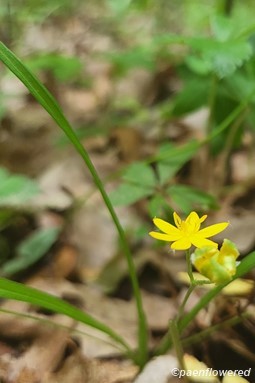
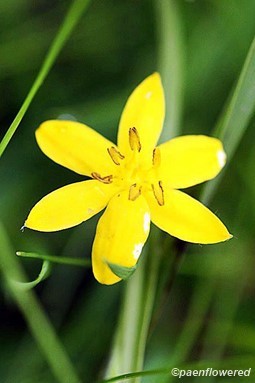
Native wildflower with grass-like leaves and star-shaped yellow flowers
Hypoxis hirsuta yellow stargrass

 Add to MyPlants
View Locations
Add to MyPlants
View Locations
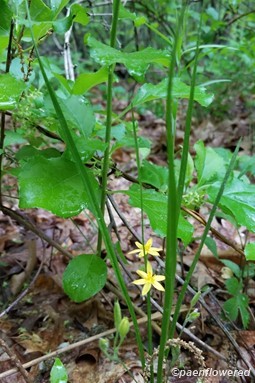
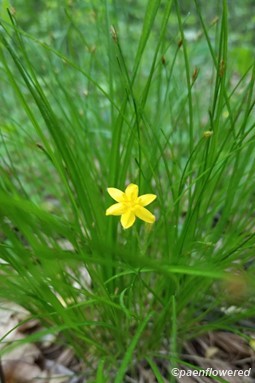
This native perennial flower is placed in the newly formed Hypoxidaceae (stargrass) family. It had previously been placed in the Amarylidaceae, or daffodil family and in the lily family. The leaves are upright and grass-like and often hard to distinguish from the true grass leaves that may grow around the plant. The leaves and flower stems all grow from a small underground corm.
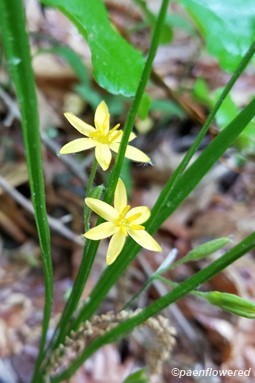
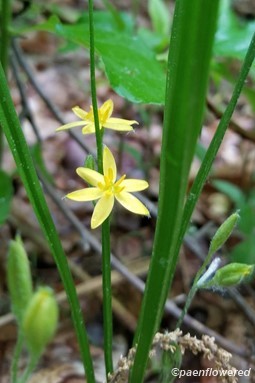
The six-pointed star-like flowers are very distinctive. Each flower is about ½ to 1 inch in diameter. The points of the flower are formed by 3 petals and 3 sepals that have the same color and shape. There is one central pistil. Although the open flower is bright yellow, the underside of the petals and sepals are greenish and hairy. These flowers produce no nectar but are visited by several small bee species for pollen. There is sometimes a mild floral scent. The flowers occur in loose clusters at the top of a hairy stalk that is 3-8 inches long, slightly shorter than the leaves. The fruit is a capsule that splits open usually on one side to release several shiny, but bumpy black seeds.
The plant grows in both dry and moist meadows and open woodlands. It is also called by the common name common goldstar or Eastern yellow stargrass. The species has a range from Manitoba and Maine south to Florida and west to Texas and Minnesota. The blooming period is from May to August.
Habitat & Range
Frequent in dry, open woods and meadows. Prefers full sun to part shade and well-drained, often acidic soils.
Present throughout the state except in the northernmost counties.
Range: Native to eastern and central North America, from Manitoba and Maine south to Florida and west to Texas and Minnesota.
| EMP: | FAC |
|---|---|
| NCNE: | FAC |
Phenology
Flowers May to August. Bloom duration is 2 to 4 weeks.
Characteristics
Inflorescence loose, terminal umbel-like cluster with 2 to 7 flowers
Flowers 3 petals, 3 sepals (6 tepals); tepals bright yellow above, outer surfaces greenish and softly hairy; 1 central pistil; ½″ -1″ across
Leaves medium-green, softly hairy, linear or linear-elliptic; margins entire; arise from corm; 4-10″ long, 8mm wide
Stems(scape) medium green, softly hairy, arise from corm; 4 to 8″ tall; shorter than leaves when young
Fruit small, warty capsule with rows of wart-like projections; splits irregularly; seeds several, black, shiny, bumpy
Height 3 to 10 inches (max 12)
Plant Codes
S-rank: S5 (Secure)
G-rank: G5 (Secure)
Ecology
Pollen is collected by small Carpenter bees (Ceratina), Mason bees, and Halictid bees, which provide the cross‑pollination required for fertile seed. Syrphid flies and small beetles also visit the flowers to feed on pollen. The flowers produce no nectar.
Small rodents occasionally dig up and eat the corms, but the foliage is rarely browsed and no specialist herbivores are known.
By occupying sunny gaps and open woodland floors, it helps maintain the diversity and resilience of these lightly shaded ecosystems.
Hypoxis hirsuta yellow stargrass


Comments
Have you spotted this plant in your area? We'd love to hear about your experience! Share your comments or questions about the plant below. Comments are moderated before posting.