Ludwigia alternifolia
A wetland dweller with solitary yellow flowers and cubic seed capsules
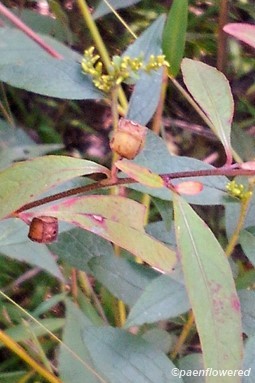
Ludwigia alternifolia bushy seedbox

 Add to MyPlants
View Distribution
Add to MyPlants
View Distribution
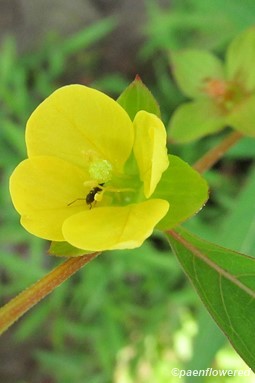
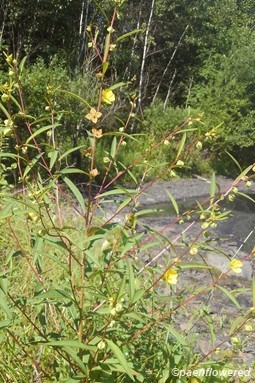
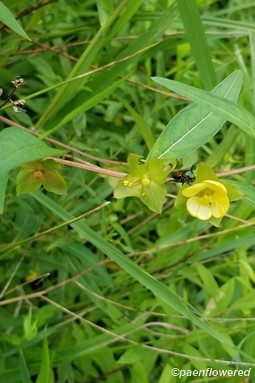
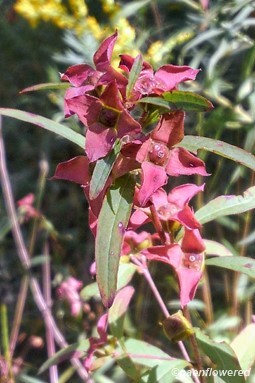
This native plant is a member of the evening primrose family and superficially the flowers look a bit like those of the common evening primrose. This species, though, has 4 wide sepals as long as the 4 petals. These are not reflexed (bent backwards). The ½ inch wide yellow flowers are on short stalks along the leaf stalk rather than at the end of the stem. The name "seedbox" refers to short, cubical pod fruit. The stem branches multiple times and is smooth. The leaves are lance-shaped, pointed and medium to light green and turn bright red in autumn. The plant grows 2-3 feet tall and is found is swampy or wet areas. It is locally common in southern Ontario and much of eastern United States. The blooming period is June to August. It is also called rattlebox.
Habitat & Range
Common in swampy fields, marshes and moist woods. Prefers full sun to part shade and moist to wet soils.
Present throughout the state except in northernmost counties.
Range: Native from eastern Canada south through the eastern and central United States, reaching as far west as Kansas, Oklahoma, and Texas.
| EMP: | FACW |
|---|---|
| NCNE: | OBL |
Phenology
Flowers June to August. Bloom duration is 3 to 6 weeks.
Characteristics
Inflorescence flowers solitary in upper leaf axils
Flowers bright yellow on short pedicels; 4 oval petals, 8 short stamens, 1 style; 4 green sepals, sepals and petals are about the same length
Leaves simple, alternate, narrow, lanceolate, pointed; medium to light green, smooth; margins entire; sessile or very short petioles; 2-4″ long
Stems erect, sturdy, branched, smooth; often reddish-tinged
Fruit dry, cubic 1/4″ capsule; smooth, 4-sided, splits at the top when ripe; seeds numerous, tiny
Height 1 to 3 feet
Plant Codes
S-rank: S5 (Secure)
G-rank: G5 (Secure)
Ecology
Bees, wasps, butterflies, beetles, and other insects visit the flowers for nectar and pollen. Beetles also feed on the foliage and floral parts, and white‑tailed deer browse the stems and leaves. In wetter sites, the submerged or partially submerged portions of this water‑loving plant offer shelter to aquatic and semi‑aquatic insects.
As a wetland perennial, it helps stabilize saturated soils and supports the food web by offering nectar to pollinators, shelter to aquatic insects, and tender foliage to browsing wildlife.
Ludwigia alternifolia bushy seedbox



Comments
Have you spotted this plant in your area? We'd love to hear about your experience! Share your comments or questions about the plant below. Comments are moderated before posting.