Field Notes from the Fern World
In this edition we explore Pennsylvania’s ancient fern lineages—plants whose roots reach back hundreds of millions of years, long before flowering plants or familiar forests appeared. From delicate moonworts to towering horsetails, these survivors of deep time continue to thrive in the places we walk every day.
The Oldest Green
Although often overlooked, ferns are some of the most widespread and durable plant species on our planet. In our modern world, ferns are one of the first species to emerge in an area after a disaster, whether it be a fire, volcanic eruption, flooding, or whatever else you can imagine that can have a major impact on the environment. They are able to do this due to the ease of dispersal of their extremely hardy spores and their very tough underground rhizomes. These features reach back well before our modern world when it comes to survival. Some fern lineages can be traced back to the Devonian period, over 400 million years ago. For comparison, the earliest record of flowering plants is from the early Cretaceous, about 130 million years ago. They have survived mass extinctions, glaciations, shifting continents, and a massive meteorite impact that wiped out the dinosaurs along with most of the other living organisms on the planet.
If you start with the ‘youngest’ known modern ferns it will be ferns in the adder’s tongue family or Ophioglossaceae. Species in this particular family do not fossilize well, so their history could reach back much farther, but spores and frond portions have been found dating back to the end of the Cretaceous period about 66 million years ago (the end of the dinosaurs). This family contains some of our most fascinating (and smallest) ferns which can be found in Pennsylvania. You can find the rattlesnake fern (Botrypus virginianus), moonworts (Botrychiums), grapeferns (Sceptridiums), and adder’s-tongues (Ophioglossum) species.
Ferns in the adder’s‑tongue family (Ophioglossaceae) are characterized by having a common stalk which divides into a sterile blade and a fertile sporophore bearing the sporangia. If you happen to come across one of these ferns with mature sporangia, just give it a little tap and you will see how easily the tiny spores can be distributed by even a gentle breeze. These small ferns can be found in a variety of habitats. I tend to find them in mixed deciduous and coniferous woodland, but they can also occur in more open and grassy areas.
Our most common species in the adder’s‑tongue family would be the rattlesnake fern (B. virginianus), which can be found in forests throughout Pennsylvania. It is also one of the earliest ferns to emerge, and its vivid green coloration is always a pleasant sight, seemingly hovering above the forest floor. It is a fairly small fern, growing up to about 50 cm tall, with a triangular blade usually around 10 cm across and 10 cm long.
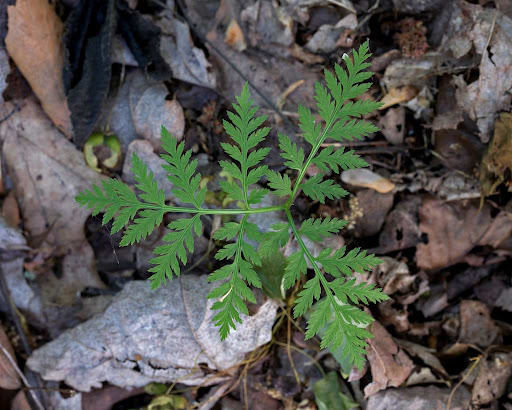
Sterile blade of rattlesnake fern
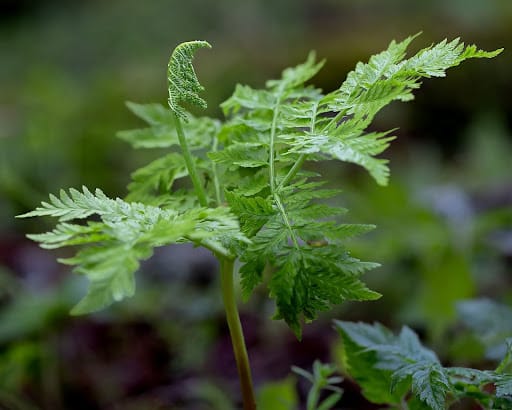
Sterile blade with sporophore
The smallest ferns to be found in the adder’s‑tongue family are the moonworts (Botrychium), which I have found in late spring and early summer. They are very small and difficult to spot, which always makes them a rewarding and exciting find. We have about 8 species in Pennsylvania of which I have found two that I have not positively id’d to species which also can be very difficult.
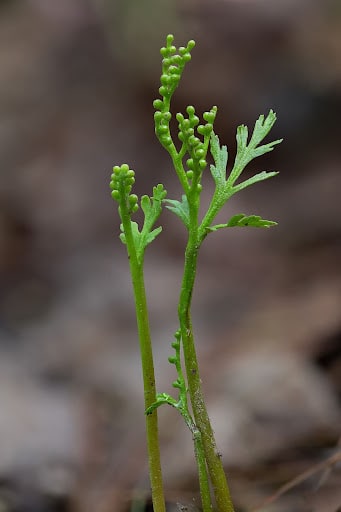
Moonwort (likely B. angustisegmentum)
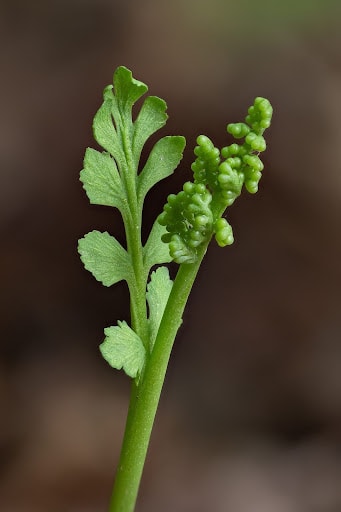
Moonwort (likelyB. matricariifolium)
Some of my favorite ferns to find in the adder’s‑tongue family are the grape ferns (Sceptridium species). While they are much larger than the moonworts, they are still a small fern, comparable in size and shape to the rattlesnake fern. However, the grape ferns are more prevalent in summer and fall and have a thicker, more leathery blade. Also, the division of the common stalk into the sterile blade and fertile sporophore is below ground for grape ferns and above ground for the rattlesnake fern. There are three species of grape fern in Pennsylvania, two of which have two recognized forms. The most common species in Pennsylvania is the cut‑leaf grapefern (Sceptridium dissectum), although species identification can be difficult due to variation within each species, particularly within the cut‑leaf grapefern.
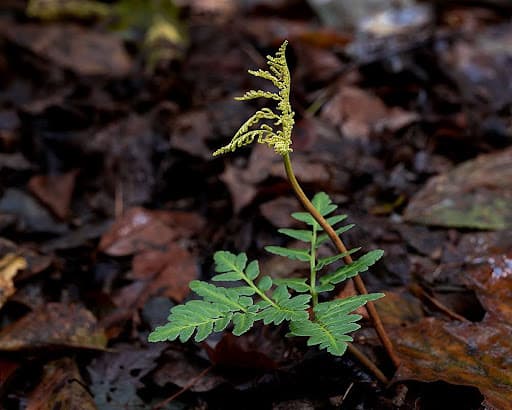
Cut-leaf grapefern (S. dissectum forma obliquum)
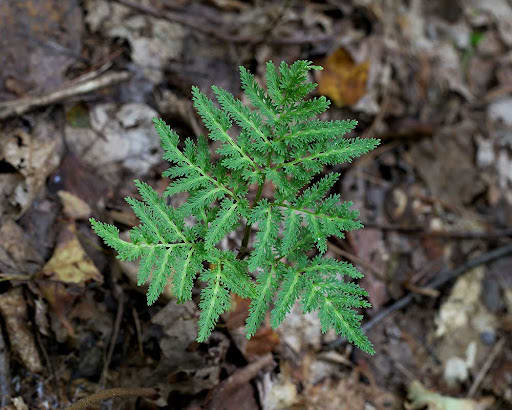
Cut-leaf grapefern (S. dissectum)
While members of the adder’s‑tongue family have been dated to about 66 million years, they do not even compare to the ferns in the royal fern family (Osmundaceae). The royal ferns are part of the subclass Polypodiidae, which has a very long and informative fossil record that can be traced back to the late Devonian period, about 400 million years ago. There are over 11,000 modern fern species worldwide in this subclass, which includes all of the “typical” ferns you would be accustomed to seeing in Pennsylvania with long, lush fronds. All of the ferns in Pennsylvania would be a lot to cover, so I will only touch on members of the royal fern family (Osmundaceae), since they are reported to have the richest fossil history.
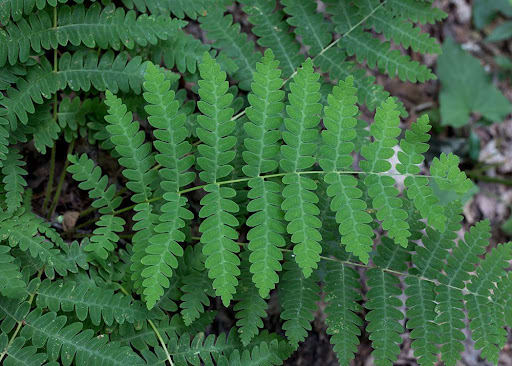
Interrupted fern (Osmunda claytoniana)
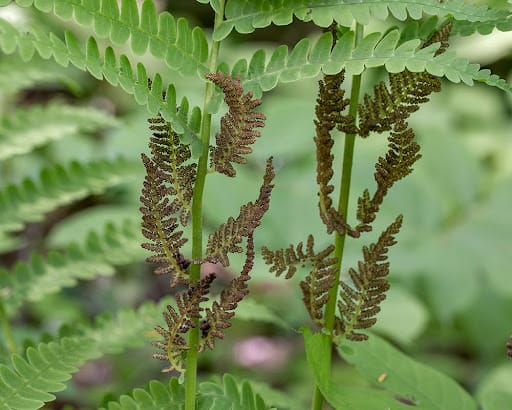
Sori of interrupted fern
We have three members of the royal fern family in Pennsylvania; the interrupted fern (Osmunda claytoniana), the royal fern (Osmunda spectabilis) and the cinnamon fern (Osmundastrum cinnamomeum). All three are large deciduous ferns that can be found in wet to moist areas. While the interrupted fern is the most interesting in appearance, at least to me, the cinnamon fern takes the lead for known endurance. This modern living species has a fossil record dating to the Cretaceous period 75 million years ago. My first time finding each of these species was a thrill and I look forward to their appearance every spring. Being more familiar with their rich and ancient history makes them even more intriguing.
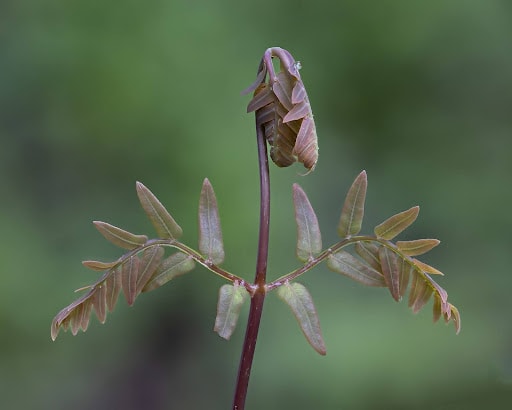
Royal fern (O. spectabilis)
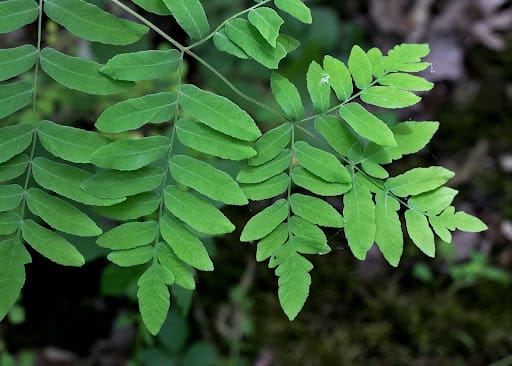
Royal fern (O. spectabilis)
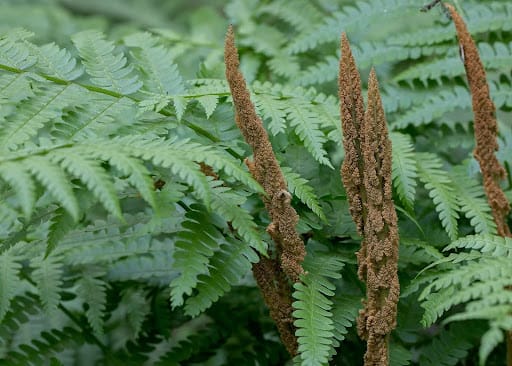
Cinnamon fern (O. cinnamomeum)
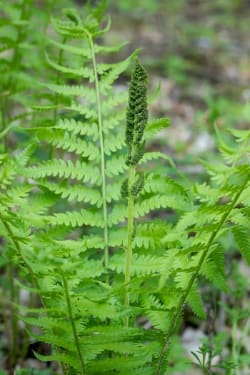
Cinnamon fern (O. cinnamomeum)
The most ancient ferns are ones most people would not even recognize as ferns (myself included): the horsetails in the family Equisetaceae. This family has only one remaining genus and about 28 species worldwide, with nine in our area. While they are not currently well represented, they were once extremely prevalent in the understory of Devonian‑period forests over 400 million years ago, slightly predating the royal ferns. Modern species of horsetails have been found dating to the Jurassic period, nearly 200 million years ago.
Horsetails (scouring rushes) have stout, stalk‑like, jointed green stems and may be branched or unbranched at the stem joints, with very small, reduced leaves. Spore‑producing cones appear at the tips of the stems. The most common horsetail in our area is the field horsetail (Equisetum arvense), which grows in a variety of habitats. The tall scouring rush (Equisetum hyemale), which is unbranched, is also fairly common in Pennsylvania and is found in habitats similar to those of the field horsetail. The woodland horsetail (Equisetum sylvaticum) can be found in moist woods and meadows in Pennsylvania and has wide‑spreading, drooping branches. Identifying horsetails to species can be difficult, but once you’ve seen one, you will know it is a horsetail.
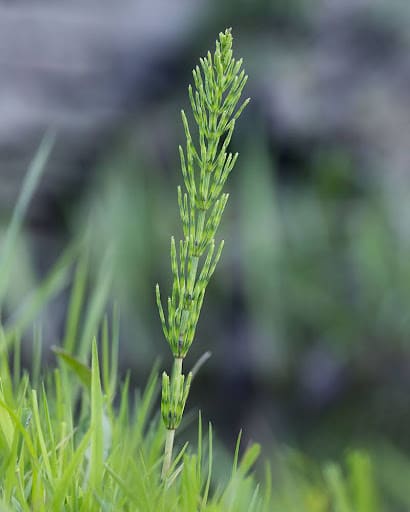
Field horsetail (E. arvense)
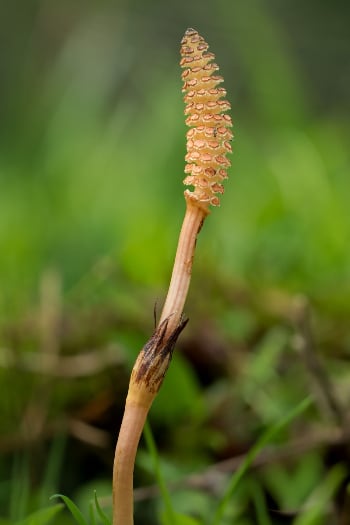
Cone (fertile stem) of field horsetail (E. arvense)
Delving into the world of ancient natural history and evolution can be exhilarating and mind‑numbing at the same time. The time scale is difficult to fathom, and the terminology can be dizzying. What is “known” is routinely being changed and updated as new discoveries are made and different dots are connected or disconnected. What connects everything, though, is survival. Ferns are among the survivors. They have seen it all and survived it all to be observed by us in our modern era (we are survivors too). While this has been only a very brief synopsis of a few families of our modern ferns with ancient histories, all of the fern species in Pennsylvania have deep and fascinating pasts, along with all the other forms of life we encounter on a daily basis. If you happen to come across any of the fern families I have mentioned, take a moment to imagine the worlds their ancestors endured, and appreciate the great accomplishment of surviving.